
By Pam Gilbert
January, 2026

A Life of Travel and Learning
I am a seasoned traveler. I have visited more than 80 countries, traveling by public bus, motorcycle, bicycle, hiking, or hitchhiking.
After retiring from teaching, I spent time traveling quietly through Central and South America. During one trip in the Andes of Ecuador, I became lost and was helped by two Kichwa (Indigenous) boys. I was both appalled and enthralled by their lives. They lived at 10,000 feet in dirt-floor, straw-roofed chosas, with little more than a bare light bulb, yet they were joyful and deeply grateful that their family allowed them to attend a weekend high school.
Fast forward more than 20 years. Through teamwork with the Kichwa – who are known for their mingas, or community volunteer labor – we built a full K–12 school system with teachers from the Ecuadorian government. With support from Engineers Without Borders Denver Professional Chapter, we also brought potable water to more than 13 villages and created scholarships for post-secondary education. Today, one of those original boys directs the school, allowing me to focus my energy on other countries in need.
Why Kenya, Why KGSA
I have long felt both repelled by and drawn to Africa. The immense poverty, often compounded by corrupt leadership, made me hesitant. However, when I learned about the Kibera Girls Soccer Academy (KGSA), I felt something different: hope.
I researched Kibera and quickly realized that, while I had seen poverty in Latin America, Kenyan poverty exists on an entirely different scale. Still, this trip, organized by some of the most thoughtful, intelligent, and caring people I have ever met, felt important. The goal was to motivate and educate girls in STEM, and I knew I needed to be part of it.
Our group included fifteen North Americans: an aerospace engineer, a test pilot, a CPA, STEM professors, and me – the lone educator. Though our time with the girls was just one week, I felt a deep responsibility to make the most of it.
Expectations vs. Reality
KGSA serves girls who did not receive the highest scores on Kenya’s national 8th-grade exam, an exam that determines who continues on to government-supported secondary schools. More than half of Kenyan girls do not continue their education beyond 8th grade.
I arrived prepared to work with “average” students. Instead, I was overwhelmed by the girls’ motivation, determination, warmth, intelligence, and joy. I cannot praise them, or the staff and security team at KGSA, enough.

Sharing Skills, Creating Possibilities
As a septuagenarian, I asked myself: What can I realistically offer?
KGSA has a Tailoring Club, so I brought sewing projects that incorporated math and creativity, including a Rummikub bag with a circular base and a teddy-bear backpack pattern. I also brought sketches of African animals so the girls could design their own backpacks. Together with Diane Gorder, we talked about how tailoring skills could become a small business.
On our drive through Kibera, I noticed people running sewing businesses using foot-pedal machines. That made the experience feel even more relevant and affirming.

Teaching, Problem-Solving, and Confidence
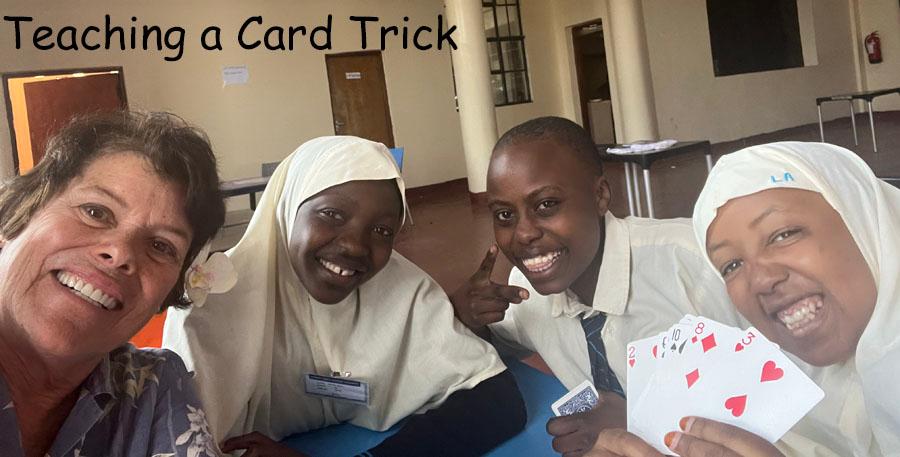
I was told that many classes relied on lecture-and-copy methods, so I prepared interactive lessons. I taught a two-hour class of 40 girls using brainteasers, logic puzzles, and math concepts drawn from real life.
We talked about Wangari Maathai, Kenya’s first female Nobel Peace Prize winner, and explored problem-solving through graphs, sine waves, and collaborative challenges. Not everything went smoothly (our whiteboard wasn’t magnetic) but the girls adapted quickly, and we made it work.
When I learned how heavily the national high school exam determines a student’s future, I shared Wangari Maathai’s words with them: “Failure is not a crime.”
We talked about resilience, adaptability, and rising to meet whatever outcome comes next.
What Stayed With Me
The girls absorbed everything -ideas, encouragement, challenges – with astonishing speed. They asked questions, embraced new ways of thinking, and supported one another generously.
Since returning home, I’ve had many sleepless nights thinking about what else I could have shared. These girls are like sponges, and the responsibility of that stays with you.

A Final Invitation
I strongly encourage you to reflect on your own skills and consider how you might share them with these extraordinary girls and the deeply caring staff at KGSA.
I suspect it will be the most profound experience of your life. And I believe you will be proud—of yourself and of the girls—for the time you spend together.

1. Edna
2. Rahma
3. Leila
4. Faith
5. (Not clear)
6. Ashina
7. Valentine
8. Gloria
9. Immaculate
10. Rachael